Saturday, 9 February 2008

Last post!

At the beginning of the project, my aims were to improve my technical skills and also create an effective opening sequence.

I think that I managed to improve my technical skills, since I can use Adobe Premier to a higher level than before. In some ways my camerawork skills have improved, although I'm still not all that confident with taking movement shots, so I do still need to improve on that.

Overall, I'm fairly pleased with our opening sequence. Some of the camera work and editing is really good, but the whole chase sequence is really irrelevant to the rest of the film. In fact, only the last shot of the photos on the wall really has any relevance to the rest of the film. In retrospect, when thinking of ideas for our opening sequence, we probably should have also considered what the rest of the film would be about.

During the project, I've learnt a few things. For example, I've learnt how to work in a group with people I wouldn't have necessarily expected to work with. Other things I've learnt include:

  • Shooting outdoors in the winter is perhaps not the best of ideas.
  • Chase sequences are really quite hard to shoot well

On the whole, I think the group worked quite well together. There were a few disagreements towards the end of the project, but we generally managed to work them out. I was quite good at compromising, but I do think that I probably should have demonstrated more leadership skills and been more assertive in expressing my opinion. This is something that I will need to keep trying to improve on.

Narrative image

The narrative image of a film can be set up in a number of different ways, for example DVD covers and film posters. A film's narrative image helps to set up audience expectations as to what a film will be about and what the themes might be.

Occasionally, a film's narrative image created will not be entirely accurate. A recent example of this is Tim Burton's 'Sweeney Todd'.

This 'Sweeney Todd' poster sets up the genre and themes of the film quite well. The tagline ('Never Forget. Never Forgive') suggests that revenge will be a very important theme in the film. The razor in Johnny Depp's hand appears to be Sweeney Todd's weapon of choice. The title of the film gives information about the main character and the location of the film. The blood splatter across the title also suggests that blood will also be a main feature of the film.

However, there is nothing prominent on the poster to indicate that the film is a musical. In the small writing at the bottom of the poster it does say that the film is based on the musical by Stephen Sondheim, but admittedly most people won't actually pay all that much attention to the small writing. This was quite misleading for Tim Burton/thriller fans who were considering going to see the film. Many people expected it to be your normal thriller film, and were quite surprised to find that it is in fact a musical. Although Sweeney Todd really is a lot darker than most musicals, many people who watched it were quite disappointed that there were songs during the course of the film.


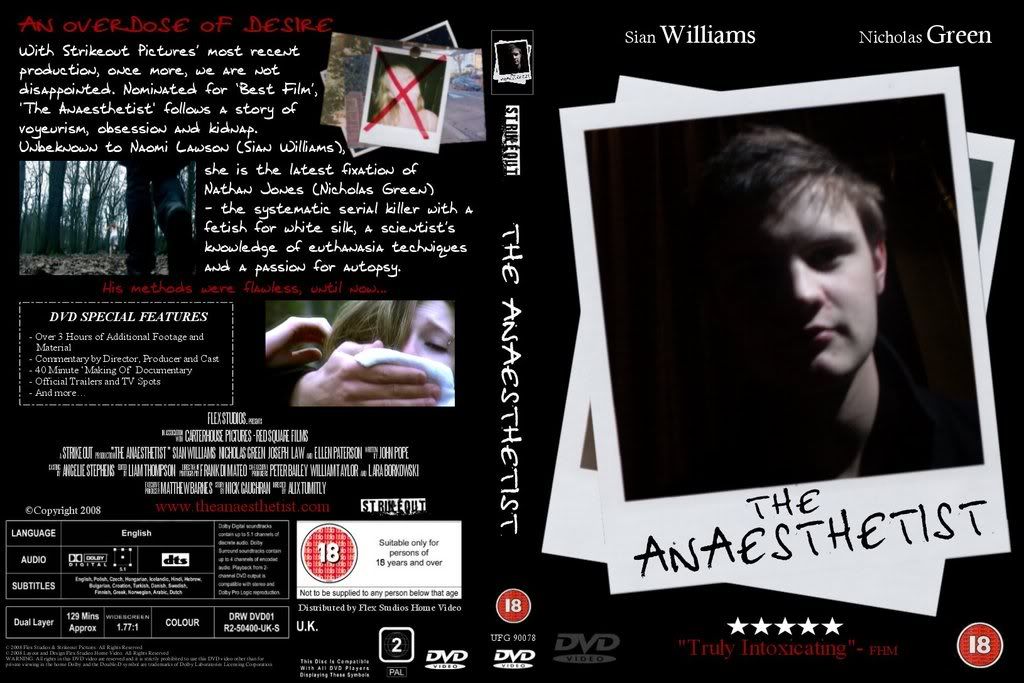
Our DVD cover is one way in which the narrative image of our film would be created.
The main image on the cover is a polaroid which links to a main element of film. The back cover also has a polaroid on it, so the audience would probably expect polaroids to appear a lot in the film. The male's face on the polaroid is half in darkness, which shows that maybe the villain leads some kind of double life. The film has an 18 certificate, which would make the audience expect that the film would be more violent than a film with a lower certificate. The actors' names are quite small on the front cover, which shows that they are not being used to sell the film. The colours used are quite conventional for a thriller cover. The black and white could link to the idea of some sort of battle between evil ('The Anaesthetist') and good (Naomi). The title of the film sets up the expectation that the film will mainly be focused on the villain. 'The Anaesthetist' suggests that the killer has a medical knowledge and this would probably be an important element of his killing style.

Sunday, 27 January 2008

Comparing and contrasting the '28 Weeks Later' opening

Similarities


  • Shot types
    Since both opening sequences contain a chase sequence, similar types of camera work is used. During the chase sequence, a variety of distances, levels and angles are used, along with lots of movement shots.

  • Location
    The opening of '28 Weeks Later' starts inside a house and then moves out into an outdoor area. This is quite similar to the location of our opening sequence.

  • Time of day
    Both opening sequences take place during the day. However, I think that it's much more effective in '28 Weeks Later'. This is because in our opening sequence it seems somewhat unrealistic that in the middle of the day, no passers by would notice a girl being chased by a serial killer. Whereas, in '28 Weeks Later' the person being chased is one of the few humans left and therefore there wouldn't really be anyone else around to think that the chase is a somewhat strange occurence.

  • Enigma
    Neither chase sequence is particularly enigmatic. This is because the person/people doing the chasing are often shown fairly clearly and aren't hidden by a mask or anything. However, other elements of both opening sequences are enigmatic. For example, in '28 Weeks Later' the audience would wonder what's happened to Alice after Don leaves her behind, and in our opening sequence the final pan across the photos on the wall would set up enigma.

  • Editing techniques
    In both our opening sequence and the opening of '28 Weeks Later' use straight cuts throughout the sequence. During the chases, fairly short takes are used to create a fast pace.

  • Sound
    Both opening sequences use non-diegetic and diegetic sound. But, I do think that the music in '28 Weeks Later' works a lot better than our music does.
Differences


  • Themes
    The themes in our film and '28 Weeks Later' are extremely different. 'The Anaesthetist' is to do with voyeurism, obsession and serial killing whereas '28 Weeks Later' is more about a pandemic.

  • Pace
    The opening of '28 Weeks Later' starts off a lot more slow paced than our opening sequence. Then, once the zombie things appear, the pace becomes much faster.

  • End of the chase
    The chases end very differently. In '28 Weeks Later' the person being chased escapes, whereas our victim gets caught.

Finished Opening sequence


Overall, I'm fairly pleased with the opening sequence that our group created. I think the mise-en-scene works well - particularly the character's dress codes and the location. I think we did quite well in terms of shot variation since we had lots of different distances, angles and levels. I particularly like the low level tracking shot of the villain's feet, with the victim in the background. I also think that the diegetic sound worked very well, especially sound of the rustling leaves at the beginning. The slow shutter speed was also really good at conveying how drugged the victim was.


There were also a few things that we could have done better. Some of the movement in some shots could have been a bit smoother (where necessary), but this could really only have been done with even better equipment. And, I think the capture at the end could have had a bit more impact if we'd shot if slightly differently and used some different non-diegetic sound. The final shot (a pan of the pictures on the wall) is a bit too dark, and this means that the picture of the new girl cannot be seen very clearly (particularly in the YouTube video), so it would have been much better if the shot was lit a bit better.

Saturday, 26 January 2008

Audience Feedback

I asked my friends to fill in the questionnaire that the group created and here are a couple of responses.

This is a response from my friend who's in university and doesn't normally watch thrillers. I thought it was quite interesting to see how the opening sequence came across to someone who normally wouldn't watch this type of film:


Age: 19
Gender: Female

1. What is the name of this film and can you tell us what happens in the sequence?
The Anesthetist. An 18-year old white girl is followed through a deserted woodland area by a white male. She wears little, even unsubstantial, clothing and has perhaps suffered an assault beforehand and has run away from her attacker or been dumped there. This is maybe suggested through the fact her shoe has come off her foot. The attacker finally catches up with the girl and she is drugged. Her lifeless body is dragged through the woodland. The scene then changes to what the viewer assumes to be the killer’s residence and the audio is a voiceover from a news report on the succession of murders of young girls. We learn that the drug was the "toxic sedative" Chloroform. The killer crosses off photos of the lifeless bodies of the young girls in what could be said to be a satanic shrine.

2. What genre category would you put this film into and why?
Thriller/mild horror due to the content of the piece and its storyline.

3. What do you think the rest of the film will be about?
I think that there could perhaps be a continuation of the killing spree with perhaps more involvement of members of the local community. This would maybe follow the ordeals of more young girls, most possibly all from the same area. Interaction between the killer and the rest of the community would no doubt be a focus. A completely different stance could be taken though and the film could focus on what it was like to be in the killer’s mind.

4. And would you go and watch it?
Though the story is intriguing and the air of suspense leads the viewer to want to know more, in honesty it is probably not the kind of film I would be likely to go and watch at the cinema due to my personal preference in film genres. I am not a major fan of thriller/horror films.

5. What works well in the sequence and what do you think could be improved?
I feel the suspense in the opening shot of the victim on the floor with a shoe missing from her foot is highly effective in gripping the viewer’s attention from the start. I believe the music suits the piece very well as it definitely sets the eerie mood without being too over-dramatic and unbelievable. The way the shot flicks back and forwards between the killer and the victim is really effective as it really picks up the pace and makes it seem as though the killer’s approach is a lot faster than you’d think it would be. I’m not quite sure how to interpret the crossing out of photos by the killer. I think that it perhaps seems a bit over-dramatic and maybe comical to put a cross through the photos with a red pen. However, it does add to the eerie feel of the film with the photos being of the lifeless bodies as opposed to when the girls were still alive.

6. Do you think it is a British, American or European film?
British

7. What sort of cinema would you expect to see this film in? (e.g. Arthouse cinema, Multiplex etc)
I find it difficult to answer this without knowing where the storyline was going. However, from the opening I would probably say it was the kind of film most likely to be shown in more of an Arthouse/independent cinema.

8. What would you give the opening sequence out of 10?
8 out of 10. I’ve perhaps been a bit harsh here with the mark due to the fact I am not a big fan of thriller or horror films. Having said that though, the sequence is definitely gripping and the stark contrast between the woodland scene to the killer’s home is rather chilling. I also think the anonymity of the killer makes it more chilling as the viewer never sees his face clearly. For fans of thriller films I’m sure they would be compelled to watch on and discover more. The way the film grips the viewer’s attention right from the first few seconds is a major achievement.
-----------------------------------------------------------------
I thought it was interesting to see that even though my friend doesn't normally watch thriller films, she was still easily able to identify the genre signifiers as well as guess what the rest of the film would be about.
-----------------------------------------------------------------

And here's the response from my other friend who finished doing her degree in film theory last year:

Age: 22
Gender: Female

1. What is the name of this film and can you tell us what happens in the sequence?
The name of the film is The Anaesthetist. The sequence shows a young woman being chased through the woods by a man, who eventually catches her. We are then shown a series of photographs of other young women. The photographs all have red crosses through them. We stop on a photograph of the woman we saw being chased, and then the killer takes a red pen and draws a cross on her photograph too.

2. What genre category would you put this film into and why?
I would suggest that this film falls under the genre of slasher-horror. This is because it follows several of the conventions of the slasher genre, in particular a young woman wearing white being chased by a mysterious man.

3. What do you think the rest of the film will be about?
After watching this opening sequence, I would think that the rest of the film would follow a group of young girls, some of which would also become victims of the killer. There would be some mystery as to who the killer is, but it would be revealed in the final sequence. I would guess that there would be a "heroine" who would survive the film and stop the killer.

4. And would you go and watch it?
I would go to see this kind of film; its target audience would probably be teenagers to early 20s, primarily male, but also with some female appeal. The film's opening sequence reminds me of several other slasher-horror films, such as Scream, Halloween and I Know What You Did Last Summer.

5. What works well in the sequence and what do you think could be improved?
The sequence contained quite a few low angle shots, these were very effective when showing the girl running away. The framing of the shots was impressive, the focus on the feet instead of the whole body added to the suspense and confusion as to who the man is. The music was eerie and helped to create suspense throughout the sequence. Also, I think the slow pan at the end of the sequence, showing the photographs of other girls, clearly developed the notion that this was a serial killer, as opposed to a one-off kill.
In my opinion, one thing that could be improved is that the audience see too much of the killer's face. In order to further create tension for the rest of the film, I think it would be better to obscure the killer's face either with a mask or an item of clothing, such as a hat, scarf or hood. Also, as it was filmed on a handi-cam, this can be quite effective during chase sequences and for establishing point-of-view shots, but beware of OVER using them, as it can create motion sickness for the audience!

6. Do you think it is a British, American or European film?
The film looked like it would be American. It follows similar patterns to other American films of similar genre, and therfore I would think it would be an American film. It could be perhaps a British take on a predominantly American genre.

7. What sort of cinema would you expect to see this film in? (e.g. Arthouse cinema, Multiplex etc)
I would expect this film to be shown in a multiplex. I would imagine it to have quite a high budget and that it would open on many screens nationwide.

8. What would you give the opening sequence out of 10?
I would give the sequence 7 out of 10. It is effective and enticing, creating suspense and intrigue as to why the killer is murdering these girls. I am not entirely sure I like the title of "The Anaesthetist", it is quite long and complicated, but other than that the clip is well-made, well-edited and well-acted.

-----------------------------------------------------------------

The point that my friend made about 'The Anaesthetist' looking like an American film was very interesting. I think that she was right in saying that the film could be a British take on a predominantly American genre, since most (recent) well known serial killer films are American.

Friday, 25 January 2008

Applying Narative Theories to our film/opening sequence

Levi-Strauss's Oppositions

The binary opposites that appear in 'The Anaesthetist's opening sequence and would appear in the rest of the film

Good vs. Evil: Naomi/Amy vs. 'The Anaesthetist'
Hero vs. Villain: Naomi vs. 'The Anaesthetist'
Dark vs. Light: 'The Anaesthetist' vs. Naomi/Amy
Male vs. Female: 'The Anaesthetist' vs. Naomi/Amy


Barthes Action/Enigma Codes

Action codes in the opening sequence:
  • Amy picks up her shoe

  • Amy starts running

  • Amy is hallucinating

  • Amy falls over

  • Amy gets drugged by the killer

  • The killer strokes a photo of his new fixation


Enigma codes in the opening sequence:

  • Where has Amy run away from?

  • Why is she wearing that white dress?

  • Why does he choose to chloroform all his victims?

  • How many girls has 'The Anaesthetist' killed?

  • How long has he been stalking the new girl for?

Propp's Character Types

In the opening sequence, two characters are identified. But, the girl is killed and a new girl is briefly introduced. So, so far in the film only two character types can be identified:

The Hero: Naomi Lawson - on the DVD cover it is implied that Naomi will be the one who finally stops 'The Anaesthetist'

The Villain: 'The Anaesthetist' - 'The Anaesthetist' is the villain in the film since he's the character who has killed lots of people. However, if the film was focusing on his mind and his reasons behind killing, he could be perceived to be more of an 'anti-hero' rather than a villain as such.

Thursday, 24 January 2008

Sub-genres

Our group's thriller would most likely come under the crime thriller sub-genre.

A crime thriller is defined as one which is more focused on the criminals and their lives rather than the policemen who are trying to capture them. So, in relation to our film, the 'Anaesthetist' would be the main focus of the film. However, crime thrillers also usually focus more on action rather than the psychological aspects of a criminal. This wouldn't really be the case in our thriller. Although there would probably be some 'action' like the kidnapping of more girls, it would not happen often enough to be the main focus of the film.

Our thriller also has some aspects of a psychological thriller. This is because the film would probably focus on the killer's mind and the reasons behind his actions, rather than his actions themselves.

Other thriller sub-genres include:
  • Horror Thriller
    Horror thrillers contain the element of fear throughout the film. The main character is or will often become the victim.
    Example: 'Hostel'
  • Action Thriller
    Action thrillers often feature a race against time with lots of violence.
    Example: 'The Bourne Identity'
  • Drama Thriller
    Drama thrillers contain more character development than other thrillers and they are often more slow-paced than other thrillers.
    Example: 'Perfume: The Story of a Murderer'
  • Supernatural Thriller
    Supernatural thrillers normally show protagonists either battling an evil paranormal force or stuck in a situation caused by ghosts or other paranormal beings.
    Example: 'The Ring'

Tuesday, 22 January 2008

'I Know What You Did Last Summer' chase sequence

The chase sequence leading up to Helen's death in 'I know What You Did Last Summer' was quite inspirational as it contained many similar ideas to those featured in our group's opening sequence.


This chase sequence was quite inspirational since there was quite a variety of distances and levels. I think that this chase sequence was quite inspiring when we were trying to think of the different types of shots for our own chase sequence. I think the rack focus shots were particularly inspiring, though unfortunately we couldn't manage to actually do this properly. Other shots that I thought were inspirational were: the low level close-up of feet running/walking out of frame and the aerial shot of the killer walking towards the shop. We tried out both of these types of shots, but only used the low-level feet close up in our opening sequence. This is because there wasn't really anywhere that the aerial shot of the villain would fit in properly.


Comparing our opening sequence to this chase sequence


Similarities


  • Costumes
    In both 'I Know What You Did Last Summer' and our chase sequence, the victim was wearing a fairly short strappy dress and the villain was dressed in all black. But, our victim's dress was white.
  • Location
    Whilst the actual locations were different, both locations were deserted to emphasise the victim's isolation.
  • Shot types
    In both chase sequences, there were quite a variety of different shots - with lots of different levels and distances.
  • Sound
    Our chase sequence and the chase sequence in 'I Know What You Did Last Summer' used both diegetic and non-diegetic sound. Diegetic sound is used to add to the realism of the chase sequence and non-diegetic sound is used to add to the tension of the scene.
  • Editing techniques
    Both chase sequences used straight cuts with fairly short takes. This helps to create and maintain a fast pace throughout the chase sequence.


Differences

  • Non-diegetic sound
    In our chase sequence, the music was a lot more prominent than in the 'I Know What You Did Last Summer' sequence. I think that maybe the music used in 'I Know What You Did Last Summer' was more successful, since it wasn't quite as noticeable and blended in more with the scene.
  • Enigma
    Enigma is more important in the chase sequence in 'I Know What You Did Last Summer'. Our chase sequence wasn't really all that enigmatic, because although the audience never sees the villain close-up, he is still a lot more recognisable than the villain in 'I Know What You Did Last Summer'. But this is probably a lot to do with the main focus of the film. So, in 'I Know What You Did Last Summer' the main focus is finding out who the villain is, whereas in our film the main focus would be the villain and his new victim.
  • End of the chase
    At the end of the chase, our victim gets caught whereas the victim in 'I Know What You Did Last Summer' manages to escape (for now). This is because our victim was the conventional first thriller victim who gets killed, whereas the victim in 'I Know What You Did Last Summer' was a much more important/key character.
  • Time of day
    Our chase sequence takes place during early morning/daytime whereas the chase in 'I Know What You Did Last Summer' takes place at night.

DVD Cover

Here's our group's DVD cover (created using Paint Shop Pro)


Larger version of our DVD cover

Monday, 26 November 2007

Avoiding problems

5 things I can do to help the group to avoid problems when shooting
  1. Continuity problems
    I will try to ensure that we avoid continuity problems, perhaps by taking still shots of actors/the location to make sure that these things look the same from week to week.
  2. Forgetting equipment
    I'll try to sort out all my stuff for the shoot the night before, and then double check everything a couple of times before leaving the house on the day of the shoots.
  3. Being efficient when shooting
    I'll try to make sure that the group stay focused when shooting, to make sure that we're as efficient as possible. This will be particularly important for our real shoots.
  4. Compromising
    If the group have different ideas about something, I'll try to compromise in order to make sure that everyone gets a say in what happens.
  5. Being honest and open with the group
    If I don't think something will work, I will be honest about it and then as a group we'll probably have to have some sort of discussion to try and sort out the issue.

Tuesday, 13 November 2007

'When A Stranger Calls' (2006) Opening Sequence

The sequence starts with the "ScreenGems" graphic. Towards the end of the graphic, there is the sound of a phone ringing twice. Then at the end of the "ScreenGems presents" black title screen, the phone is picked up and you can hear the voice of someone (sounds like a girl) saying "Hello?", then there's a male voice asking (quite creepily) "Is that Alice?" and the girl replies "No, I think you've got the wrong number". Meanwhile, the opening credits continue. Then the man says "Oh... well... what's your name?" and the girl replies "This is Stacy.... uh, who is this?" . The image of a house (at night time) then fades from black. The shot is slightly low angle, looking up at a window on the first floor of the house. We then hear the girl saying "Hello?... Hello?". The camera then pans right and a ferris wheel appears in the background of the shot (behind the house). The camera continues to pan right and then the audience gets a full view of a fun fair. The camera then tracks two children (medium long shot) running through the fair ground. There is then a pan of a man walking his dog. There appears to be a frame within a frame, which makes this shot appear to be a point of view shot. There are some jump cuts while the man is walking his dog, which is quite disorienting for the audience. Then there is a shot of a girl on a carousel. There is then a very quick cut to a shot of the house we were shown before, and then it goes back to the girl on the carousel. This is very disorienting for the audience since you can barely tell what disrupted the shot of the girl on the carousel. The camera pans from the carousel to the house we were shown earlier. You can then hear the phone ring once, then a girl picks up and says “Hello?”. Then there are very quick takes of close-up shots of the house, then long shots of the house. Then we hear the girl say “Who is this???”. The shot then changes to a shot of one of the fairground rides spinning around. Then there is a shot taken from behind an elderly couple sitting on a bench outside, the man waves at another man walking his dog. Then the shot changes to one of another house, we see someone walk out the door and call the names of 3 people. Then the camera pans right. The camera then moves up (sort of like a tilt, but the whole camera appears to be moving) to reveal the ferris wheel behind the house. A pink neon sign then comes into view, and the camera moves up until you can see the ‘Jesus’ in green neon lights. The woman who’s just left her house continues to call other character’s names. We then hear a small scream and during this scream, there are jump cuts of the house. The woman walks down the steps at the front of the house, then there are some more jump cuts to closer up to her and then further out. She then calls “A.J.!” and looks around, then calls “Charlie! Catherine”. Then the shot changes to a man with a dog going through the gate at the front of his house. Then we go back to the fair ground, with a low level shot of people at the fair ground, children playing etc. Then there is a shot of the first house we see, and the phone rings again. A girl (it sounds like it’s been the same girl on the phone throughout the whole opening sequence) and says “Hello? … Hello?… Please stop calling me!”. There is then a close up of a window on the top floor of the house, and the faint sound of a scream. Then it cuts to a shot of some wind chimes hanging off a branch on a tree, and the camera zooms in to the wind chimes. Then a silhouette of a person sprints past the wind chimes, and the sound of a scream is heard. Then the audience is taken back to the fair, with a close up of the middle part of the carousel. The name of the film then appears on screen, over the top of the carousel. Then there is a shot of another fairground ride (it looks sort of like a pick-axe stabbing downwards, which is presumably meant to be symbolic) , then the camera pans left to the ferris wheel, and keeps panning until it gets to the house that we were first introduced to. Then the light comes on in one of the first floor level windows, and the silhouette of a person can be seen, and there’s a really horrible scary scream. There’s then some more jump cuts which take you closer then further away from the window, very quickly. Then there are various shots of the fun fair, with people on different rides etc. All the while, there’s another 2 long and scary screams. Then the camera tilts up to follow a red balloon that has been let go and is now floating through the sky.

--------------------------------------------------------------------------------------

Apparently this film isn't actually very good, but I thought the opening was quite well done. It was very good at being disorienting for the audience, since quite a lot of jump cuts were used (more than the ones I mentioned above). I thought this was a very interesting editing technique, since it was clearly done to deliberately disorient/confuse the audience. In the opening, no main characters are introduced really, only the voice of one girl (who is presumably killed and is the character doing the scary screaming) and the voice of a creepy guy (who is presumably the villain in the film). The cross cutting was also very interesting, especially since the two scenarios were very contrasting to each other. I also liked the use of enigma. The audience would wonder:
1. Who is Stacy?
2. Who was the voice at the other end of the phone (i.e. the creepy guy)?
3. Who was the scream at the end coming from? (I assumed it was Stacy, but can't be sure really)
I also think, that it's really good when there's a death in the beginning of a thriller film, so that might be an idea for the real project :). Also, the screaming was good because it scared me a bit and it sort of catches you off-guard, which made it even more scary. But yeah, overall, I thought this opening was really well done.

Monday, 12 November 2007

Atonement: Steadicam Sequence

I know Atonement's not a thriller in any way whatsoever (one of my favourite films though), but the camera work in the following sequence is so cool and I thought I'd quickly blog something about it.


The camera tilts down from the top of a ship (on land) to the main character of the film (Robbie, played by James McAvoy). Then the steadicam movement kicks in and the camera starts to follow Robbie as he walks along the shore. Robbie then walks out of frame, and the camera continues to move without following him. The audience then begin to get a sense of the surrounding as the camera moves around the scene. The whole sequence is just one long take, so there's not really much edited together. The sequence is fairly slow-paced because of this one take, and this works really well in taking the audience away from the story for a minute, just to give them an overview of the location. From earlier on in the film, the audience is shown that this part of the film is set during the time of World War Two (the mise-en-scene and character dress codes all indicate this). So, this whole sequence is used to show the consequences of war. Then at the end, the audience is brought back to Robbie, and the narrative continues.

The clip above is just a part of the 4 and a half minute long steadicam sequence.

Tuesday, 6 November 2007

A long time ago...

...me and my cousins made a short film (with the help of my uncle, about 4 years ago now) and I hadn't thought about it in a long time. But then, the other day I watched it again and realised that it could be quite useful for this project, since our film was in fact a thriller. . Instead of showing it to anyone (no-one will ever see it since you know, I was in it and it's thoroughly embarrassing), I thought that I would have another look at the opening and then blog something about it :)

**Update (08/11/07): Added some screencaps from the opening. They're a bit rubbish quality since it wouldn't work when I tried to screencap the video on my computer, so I had to use my digital camera to take pictures of the TV screen... **

---------------------------------

So the film starts with a black screen, then the music starts. Then the opening credits start and there are 4 titles (all of which appear over black screens) saying:


  1. "Stephens Motion Pictures"

  2. "in association with"

  3. "minidrama productions"

  4. "presents..."

  5. "Death Diary" (that, was the film's name... I realise that I didn't mention that earlier...)


The audience is then introduced to two young female characters (meeee, and my cousin) who are sitting at a bus stop (during the day) having a conversation about a television show. Then one of the girls' (I'll call her Girl Number 1 for the purpose of this blog) mobile phone rings, and the other girl (Girl Number 2) continues to play a game on her mobile phone. Girl Number 1 picks up the phone and then tells Girl Number 2 that it's their dad on the phone. Girl Number 2 then tells Girl No. 1 to put him on speakerphone.


The audience then hears the father's voice telling the two girls that their grandmother has fallen sick, so their aunt has gone to stay with her, and the girls will have to stay with their grandmother too. So then Girl No. 2 protests saying "But Dad, Grandma's crazy!" and Girl No. 1 says "Yeah, and we haven't been there in ages". The reason behind the girls going to stay with their Grandma is then explained when their dad says "There's no-one else you can stay with and I've got a plane to catch". The Girl 1 then says goodbye and hangs up the phone. Both girls walk away from the bus stop and start to make their way to their grandmother's house.

The scene then cuts to the two girls walking through a pathway in a field-like area, where they are discussing the fact that they have to stay with their grandmother just because their dad has a business trip.


There is then some cross-cutting between the girls walking and a floor-level shot of another female character walking out of a front door and putting something under the door-mat.
The two girls then talk about how their grandmothers only friends are her "stupid neighbours" named Edward, Mary and Elizabeth, then Girl 1 comments that the neighbours must all be as mad as she [the grandmother is]. The two girls then meet up with their aunt (the other female character introduced earlier on), and the aunt explains that she can't look after them this weekend because their grandmother's been admitted to a hospital in Newcastle and explains that their grandmother's been "acting really weird lately", so the aunt is going to go and stay with her for a couple of days. Girl 2 says "Dad's not going to like us being alone...", Aunt Nina replies "Yeah I know, but I'll only be gone a couple of days... and I will phone him". Girl 1 then asks how they can get into the house, and Aunt Nina replies that there's a key underneath the mat (which, the audience saw being put there earlier on). The girls say goodbye to their aunt and begin to go their separate ways, but then the aunt stops and says to the girls: "Don't go in Grandma's room, she doesn't like people going in there".

The scene then changes to a medium shot (from inside the house) of the two girls opening the house's front door, both girls look slightly worried. Girl 1 says "You first", then Girl 2 says "Why's it always me??" and then Girl 1 says "because you're the youngest!" and pushes Girl 2 into the house, follows her in and then shuts the door (lots of shot/reverse shots here). Then there's a high angle long shot of the two girls looking up the stairs and Girl 2 commentinG "It's kind of creepy here, isn't it?".


There is then a reverse shot of the stairs and a reflection (through a mirror) of the first floor of the house. Then there's shot (taken from the same angle and distance as before) of the two girls then going into the kitchen through the door on the left. Then it goes back to the reverse shot of the stairs and the first floor of the house, a mysterious female figure (with her face unrecognisable because it's covered) comes around the corner to the top of the stairs.


Then there's some more cross-cutting between the mysterious female character walking down the stairs and the two girls having a conversation in the kitchen. The girl's then decide to go into the garden. There's a shot from inside the kitchen, looking through the window onto the two girls in the garden. The mysterious female figure then walks into the shot, facing the garden, and appears to be watching the two girls. It then cuts to the girls smelling flowers, then cuts back to the over-the-shoulder, frame-within-a-frame shot of the mysterious female character watching the girls.


The mysterious female character then walks out of the frame and the two girls are then shown sitting down on a bench at the back of the garden. Then the scene fades to black.

--------------------------------------------------------------------------------------------

Most of the dialogue in this is a bit silly, and most of the opening doesn't really seem very thriller-y. But, I do think that other than that it's quite good really. (And I'm allowed to say that since I didn't shoot or edit it).

The shot variety is pretty good, since lots of different distances, angles, movements and levels are used. I think the editing is really well done too, the cross-cutting works really well. The sound used is mostly diegetic, and the non-diegetic sound used helps to create tension.

But most importantly, the opening sequence helps to create enigma in very little time (the parts I've described above only take place over about 3 and a half minutes). The opening sequence raises the following questions:

  1. Where has the girls' father gone on his business trip?
  2. Will the girls' grandmother's neighbours (Edward, Mary and Elizabeth) become more relevant later on?
  3. What happened to the girls' grandmother that made her "act really weird lately"?
  4. Why doesn't the girls' grandmother like people going in her room?
  5. Who was the mysterious figure on the stairs/watching the girls?

....I have to say, I never realised that this film we made would be useful for future schoolwork!

Opening sequence credits conventions

I've watched a few thriller opening sequences, and have made a list of the credits that appear in them. By doing this I have learnt about which credits/graphics always/often appear and this will help me when it comes to creating my own thriller opening.

Flightplan
  • 'Touchstone' graphic
  • 'Imagine Entertainment' graphic
  • 'Touchstone pictures and Imagine Entertainment present'
  • 'a Brian Grazer production'
  • Actor name
  • Film name
  • More actor names
  • Casting
  • 'Music composed by...'
  • Costume design
  • 'Editing by...'
  • Production Designer
  • Director of Photography
  • Executive Producers
  • 'Produced by...
  • 'Written by...
  • 'Directed by...
Firewall
  • Warner Brothers graphic
  • Village Roadshow Pictures graphic
  • 'warner bros. pictures presents'
  • 'in association with village roadshow pictures'
  • 'a beacon pictures/john shestack/thunder road production'
  • 'a richard loncraine film'
  • Actor names
  • Film name
  • More actor names
  • 'Casting by...'
  • 'Costume design by...'
  • 'Music by...'
  • Co-producer
  • 'Edited by...'
  • Production designer
  • Director of photography
  • Executive producers
  • 'Produced by...'
  • 'Written by...'
  • 'Directed by...'
1408
  • Dimension Films graphic
  • 'Dimension Films presents'
  • 'A Lorenzo Di Bonaventura production'
  • 'A Mikael Hafstrom Film'
  • Actor names
  • Film name
  • More actor names
  • 'Casting by...'
  • Costume designer
  • 'Music by...'
  • Editor
  • Production designer
  • Director of photography
  • Associate producers
  • Executive producers
  • 'Produced by...'
  • 'Based on the short story by...'
  • 'Screenplay by...'
  • 'Directed by...'
When a Stranger Calls
  • ScreenGems graphic
  • 'ScreenGems presents...'
  • 'A David Entertainment Production'
  • 'A Film by...'
  • Actor names
  • Film name
  • 'Casting by...'
  • 'Music by...'
  • Costume designer
  • 'Edited by...'
  • Production designer
  • Director of photography
  • Executive producer
  • 'Produced by...'
  • 'Based on the film written by...'
  • 'Screenplay by...'
  • 'Directed by...'

The Number 23
  • New Line Cinema graphic
  • 'New Line Cinema presents'
  • 'a Contrafilm/Firm Films production'
  • 'a Joel Schumacher film'
  • Actor name
  • Film name
  • More actor names
  • 'Music by...'
  • Associate producer
  • Costume designer
  • Editor
  • Production designer
  • Director of photography
  • Co-producers
  • Executive producers
  • 'Produced by...'
  • 'Written by...'
  • 'Directed by...'

Conventional credits included in opening sequences
(in the conventional order they appear in)
  • Film company graphic
  • '[Film company] presents'
  • 'A [producer/production company] production'
  • 'A [director name] film'
  • Main actor names
  • Film name
  • Supporting actor names

Other credits that often appear, but not necessarily in this order:

  • 'Casting by...'
  • 'Music by...'
  • Producers/Executive Producers/Associate Producers/Co-producers
  • Costume designer
  • Editor
  • Director of photography/Cinematographer
  • Production designer
  • Writers/'Screenplay by...'

Sometimes there are also credits to indicate if the film is based on a book/other film

Wednesday, 31 October 2007

Previous Students' Opening Sequences

Innocence


One thing that I found particularly interesting with this sequence was the choice of non-diegetic sound/music. The song that was chosen probably normally isn't so creepy, but for some reason in this groups opening, it works really well. Maybe its the version of the song they chose, or maybe its the whole scenario that goes with the song that makes it so creepy... either way, I think it worked quite well.
The style of titles that they used was very effective as well, I thought, since they went for a look that was very similar to those typical anonymous notes (made from individual letters cut out from newspapers/magazines) that characters receive in thriller films. I thought that the title screens/credits were also really good at setting up what was to come in the rest of the film, since those sorts of anonymous notes are often sent in kidnap films, so it seemed likely that they would feature prominently in the rest of the film.
Enigma was used in the first minute(ish) of the sequence, there were lots of shots of hands or feet or character's backs. So for quite a while you can't really tell who the characters are. You can see that one of them is a little girl, mainly because of her height and teddy bear. But apart from that, we don't really find out much about any of the characters until a bit later on.
The very first shot (close up/big close up of a white teddy bear) was very good at representing some of the themes that seem like they will feature prominently in the film. Teddy bears connote innocence (which, is also the film's title) and are also associated with children. The teddy bear was white and white is a signifier of purity. All of these themes (purity, innocence, children) seem like they will appear a lot during the course of the film.
The use of a 'missing' poster was also effective in foreshadowing events that will take place later in the film. At first, the poster seems slightly irrelevant, but then as the opening sequence goes on, the audience then begin to understand just how relevant it really is.

Exposure


The continuity in this opening sequence was very well done. Rules like the 180 degree rule were followed, and there were some good uses of matched cuts/matches on action. Shot/reverse shot was used when the male character goes to open a door, and then we see things from the other side of the door.
The camerawork in this sequence was generally very good but a few shots stood out to me, since I thought they were particularly well done:
~ The shot looking into a an opened drawer - the camera panned quickly from the left side, to the right side and then back to the left side. This quick movement showed that the shot must have been a point of view shot, from the male character's point of view. You can tell this because the male character seemed quite panicked and was rushing and the quick pan helped to convey the sense of panic/rush.
~The low level tracking shot of the male character's feet slowly walking along a corridor - I really like these kinds of shots. I think they're great at creating anticipation since the audience begin to wonder what he's walking towards.
~ The shot from inside a room where we see the door opening - when the character first opens the door, the room is totally dark and the audience can barely even see his shadow, then he switches the light on and the sequence goes from being black and white (as it was previously) to being in colour. I thought this was very effective in showing the contrast between that room (with the pictures stuck all over the walls) and the rest of the rooms in the house.
Low-key lighting appears to have been used, which is very effective for a thriller opening (as well as thrillers in general).
The film's credits were super-imposed over the scene. I thought this was very effective since it didn't break up the film too much, and allowed the action to continue at a fairly fast pace (well, for the beginning part of the sequence, at least).
I thought that the film's title screen was really very good. The font was well chosen, and I thought the effect that they used (with the flash and then the screen/text becoming negative) was very effective in showing that cameras/pictures will be important during the course of the film.


Wanted


I thought that it was very interesting how this group had so many actors in their opening sequence. I think that the finished product works quite well, but having so many actors is something that I really really don't want to do because I think it would end up being far too complicated and hard to organise.
The mise-en-scene works really well too. Particularly the dress codes and lighting. The black costumes are very effective in conveying the 'underground' world that is being presented to the audience. Similarly, the low lighting helped to connote that 'underground' theme. Also, the character's action codes (smoking, gambling, drug preparation etc.) show that the film will be about these 'underground' type characters.
I thought that the music was also well chosen and was well-suited to the themes that were being represented.
The sequence featured cross-cutting, which worked very well since it set up the final meeting between those 5 characters and also showed how they came to that point in the first place. Lots of fades and one or two fade to blacks were used and this slowed things down a bit, but not in a bad/boring way.
We were shown a few different events taking place (all of which lead up to that final meeting) and in between these events were were the title screens were put. The titles were on black screens with white text, which could possibly have been used to try and represent the contrasting good and evil that the audience will encounter during the course of the film.

Under the Gun


I thought the camera work in this sequence was very effective, as it quickly showed us who's side we were meant to be on and which characters we're meant to sympathise with. The first few shots were out of focus, and it's soon made apparent (by something that the main male character says) that we are seeing things from a female character's point of view, and she has just been regaining consciousness (which is why the first few shots were blurry). Quite a few of the shots seemed to be from that female character's point of view, so the audience begins to sympathise with her. Low angle, point of view shots of the male character were used to make him appear to be intimidating/threatening. One shot which I found particularly interesting was one of the female character, where her face was partly in shadow. This connotes a murky past, which was further confirmed when she said "I'm not a part of this anymore" ("anymore" being the operative part).
A lot of fade to blacks and fade from blacks were used, and this made the opening quite slow in pace. But this still worked very well since their opening seems to be much more character-driven than action-packed.

--------------------------------------

I noticed that most of these opening sequence had very little (if any) dialogue. I can see why these groups had to do this, and I think that for my own thriller not having too much dialogue could be a good idea, since a lot of dialogue can complicate things when shooting. But I suppose, since we have better sound equipment this year than in previous years, it may not be so bad. But still, I don't think I want to put too much dialogue in my thriller opening. I think having a bit of dialogue is fine, and probably a good idea, but not too much.

Most of the openings weren't really very fast paced, and I think that would be a good idea for my thriller opening too, since having a film opening being too fast paced can be extremely confusing for the audience. Having a slower pace can also build up to a final event (or something similar) really well.

All of the opening sequences had a range of shot types, with shots being taken from different angles and levels. I think that this is extremely important for my own opening sequence since having a range of shots makes sure that the audience don't get bored.

Most of the opening sequences also had quite low [artificial] lighting, which was very effective since it helped to create lots of shadows and a very thriller-esque atmosphere. I think that low lighting would be good to use in my own thriller opening, but I can see how getting the lighting just right could also become a problem.

The majority of the opening sequences only had 1-4 characters in them, and I think that this is probably the best way to go about things, since it ensures that you won't end up complicating things by trying to organise shooting times for a large number of actors.

So, overall I think that looking at previous students' opening sequences was very helpful and enabled me to find out what works and doesn't work both when shooting and with the end result.

Wednesday, 24 October 2007

Zodiac Opening Sequence

The film starts with the Paramount and then the Warner Brothers logos on screen (I'm not entirely sure what the proper name for these are). In the background there are sound effects of fireworks fizzling. Then a black title screen comes up with the words "What follows is based on actual case files" on it. A song starts playing and then there is an establishing extreme long shot of a bridge and San Francisco skyline, with fireworks going off in the distance. There is then a tracking shot of some houses, taken from inside a car, with the car window as the frame within a frame. Then the words "July 4, 1969 - Vallejo, CA" appear over the shot. The car stops and beeps its horn. We then see a man closing his front door and jogging towards the car/camera. He leans through the window and says to the driver of the car "Where have you been? I've been waiting since 7". There is then a reverse shot (Medium shot) of the driver, who is a blonde haired white woman telling the man "Get in. I had to find fireworks". There is then some more dialogue between the characters and then the man gets into the car. We see the car drive away and then it cuts to the car driving up to a diner. The woman says that it's too crowded and they should go "some place quiet" , the man says okay and then it cuts to a very/extreme long shot of the car parking in a deserted area. The characters talk some more and it is made clear to the audience that the man and the woman are a couple or will potentially become a couple soon, since the woman starts flirting with the man. Characters in two other cars throw a small firework at the man and woman's car. The man swears at them as they drive off. The woman starts to gently make fun of him. The camera tracks sideways as a car pulls up behind the man and the woman's car. The man and the woman turn around and try to see who's in the other car, but the other car is totally dark on the inside. The man asks if the other car was at the diner and says he definitely saw it there. The woman tells him to "shhh...". Both characters start to look very anxious.
Man: Do you want me to tell him to leave?
Woman: Stay in the car.
The other car then drives off.
Man: Was that your husband?
Woman: *staring out of the car window* No.
Man: Who was that Darlene?
*she turns around to face him*
Woman: Don't worry about it.
Man: Don't tell me not to worry. Who was it?
Woman: It's nothing
Things seem to have become awkward between them, since they both start looking down at their laps. We then hear the screech of car brakes and the two characters watch as the other car drives back towards them. Darlene says "Oh shit" then the man begins to look more panicked and says that they should go. The person in the other car gets out of the car and then starts coming over to their car and is holding a torch, making the character unrecognisable to both the audience and Darlene and the man. The character from the other car walks from the back of Darlene's car, to the car window the man's sitting by (this character still cannot be seen properly). Loud rock music is also playing on the radio. The man then says "Man, you really creeped us out". The other character repeatedly shoots the man and Darlene. All the while, this character's face is completely in shadow. The other character begins to walk away, then comes back and shoots the man some more. Then he/she walks back to his car and the screen fades to black.

~~~~~~~~~~~~~~~~~~~~~~~~~~~~~~~~~~~~~~~~~~~~~~~~~~~~~~~~

I thought the opening of Zodiac was very effective. It did a similar thing to Scream in that both films started by showing the first 'disruption' (as in Todorov's narrative structure theory). I liked the way that the opening sequence leads the audience in one direction (particularly if they have no prior knowledge of the film or the real murder case that it's based on) and then there's a plot twist. So, the film starts sort of like a romance film, there's lots of fireworks and happy people, then the audience is introduced to a couple. This makes the audience think that the couple will be the main characters of the film. But then there's a plot twist since the characters who the audience think may end up being the main characters are killed within the first 5ish minutes. I also liked the use of enigma. At the beginning of the film, we can see that some of the shots are from inside a car. This makes the audience wonder who's car it is and where the car's going. Then when the man is talking to the person in the car, the audience wonder who he's talking to. This enigma goes away fairly early on in the opening. Enigma is used again when the man and the woman are shot. The murderer character is holding a torch in his/her hand, which casts a shadow over his/her face, making him/her unrecognisable. This enigma effectively sets up the rest of the film, since it becomes apparent that the film will be about trying to find out who this killer is.

I've already mentioned this in another blog but just to re-iterate...
1. I think that enigma in a thriller opening is very important
2. Showing the disruption of equilibrium before showing the equilibrium itself can be very interesting.

The Problematic and Ideology

The Problematic
The problematic is the main problem in a film that the main character will face and have to resolve by the end. The problematic is often used to describe what a film is about.

The problematic in Fatal Attraction
Married man, Dan Gallagher, has an affair with a woman named Alex. Alex turns out to be slightly mentally unstable and she causes lots of problems for Dan and his family.

The problematic in Scream
A serial killer strikes in a quiet town in America and the characters try to stay alive and find out who the killer really is.

The problematic in Disturbia
A teenager named Kale is put under house arrest after punching a teacher. He begins to look out of the windows in his house and starts to believe that one of his neighbours is a serial killer.

Ideology
Ideology is the main point that a film is trying to make and what a film is against.

The ideology in Fatal Attraction


  • Single women are dangerous
  • It's better to be a stereotypical married housewife

The ideology in Psycho

  • Mentally ill people are a danger to society

Tuesday, 23 October 2007

The Three Act Plot Structure Theory

This theory was created by Syd Field. Field explained that films are split into 3 sections:

Act One: Setup
Field said that the first ten minutes of the film are often the most important, since it is at that point that the audience decide whether or not they like the film. Field also believed that once the audience had made their mind up after 10 minutes, they wouldn't change their minds after that. So, the film makers have to make sure that in the first ten minutes the audience get a sense of who the main characters are and why the audience should care them, what the film's about and what to expect in style terms. During the rest of the first 30 minutes, the audience should be shown what sort of problem the main character will face.

PLOT POINT ONE: an important part of the plot

Act Two: Confrontation
This is the longest act of the film. In this act we see the main character facing lots of problems and trying (but failing) to overcome them. There is often a mid-point in the act, where the main character begins to turn things around. But at this point there's still quite a long way to go.

PLOT POINT TWO: the main character realises that the way they've been trying to resolve their problems is not working. This leads on to...

Act Three: Resolution
The main character finally takes control of the situation and will achieve a final victory.

Applying the theory to Fatal Attraction
Act One
The audience is introduced to the Gallagher family. We see that Dan and Beth Gallagher have a young daughter named Ellen. Dan and Beth are getting ready to go to a party. At this party, Dan meets a woman named Alex. When Beth goes away for the weekend, Dan bumps into Alex at his work, and then they go out to a restaurant. Then the affair begins since Dan and Alex go and have sex in Alex's apartment. During the course of the weekend, the affair progresses.

PLOT POINT ONE: Dan tries to break things off with Alex. Alex reacts badly to this and slits her wrists, Dan manages to save her.

Act Two
The audience begins to see that Alex isn't quite right mentally. Alex tells Dan she's pregnant, and continually phones him but he tries to get away from her. Then she does things like vandalise his car and boil the family's pet rabbit. Dan tries to inform the police, but they aren't very helpful. Dan tells Beth about the affair and Alex's pregnancy. Beth throws him out of the house. Ellen goes missing (Alex takes her out without the parents' permission) and Beth gets into a car accident. Dan goes to visit Beth in the hospital and he is forgiven for the affair.

PLOT POINT TWO: Dan goes over to Alex's apartment and tries to strangle her. He then comes to his senses and stops. Alex tries to stab him but he gets the knife away from her and then he walks out of the apartment.

Act Three
Beth comes home from the hospital. She's going to have a bath soon, so the bath is filling up with water (which becomes significant later on). Beth asks Dan to make her a cup of tea, so he goes downstairs to do so. Alex appears in the bathroom, talks to Beth for a while and then starts to attack her. Dan can't hear this happening since the water in the kettle's boiling loudly. Eventually, Dan hears Beth screaming so he runs upstairs to save her. He manages to pull Alex off Beth, then holds Alex's head under the water in the bath. She seems to have drowned, but after quite some time she suddenly comes up from the water. Beth then shoots Alex in the chest. The audience sees the police car outside the house, Dan shaking hands with the policeman he tried to report to about Alex, Dan and Beth hug and then the film ends.

Some initial thoughts/ideas

Quite a while ago, Emma and I had a discussion about potential ideas for our thriller. Emma came up with the fantastic idea of a female character with a femme fatale personality but an innocent appearence. I love this idea and have become a bit hung up on the thought of doing the opening in a really enigmatic way (for some reason, the thought of a close-up of walking feet, is sticking in my mind). Whatever the idea ends up being, I think it'd be really good to have a considerable amount of the opening to be enigmatic, with the main character of the opening sequence only being fully revealed right near the end of the opening . So, lots of shots of feet, hands etc but very few of the character's face.

I did also have the possible idea a while ago of a documentary style, video diary of a serial killer, type of film. But that's a bit disturbing and freaks me out a bit :S. Also, in terms of getting a variety of shot types, I don't think this idea would work since it wouldn't really enable us to do that. That and I'm not entirely sure about what could happen in the opening.

After watching the 'Scream' and 'Zodiac' openings (I'll write a proper blog about the Zodiac opening in a later blog), I've also started to quite like the idea of showing the 'disruption' (like in Todorov's narrative structure theory) first, and then showing the equilibrium stage after. But, I don't think that'd be possible to do in just 2 minutes!

So, I don't really have any set ideas yet, just a few vague ones. I think I might watch the Crime and Investigation channel (my dad watches is a lot... I'm not so keen, but it could be useful) some time to see if I can get any ideas from there :)

Sunday, 21 October 2007

Narrative Theories & applying them to films

Claude Levi-Strauss' Oppositions

Levi-Strauss came up with the idea that within films, there are pairs of themes which are known as 'binary opposites'. As implied by the name, these themes are opposite to each other.

An example that often appears in films is good v evil.

Different genres often have common binary opposites of their own. For example, comedy films often have an intelligent character and one who is silly (stupid seems a bit harsh, but I guess you could use that too).

Applying the theory to Psycho
  • Good (Marion, Marion's boyfriend Sam, Marion's sister Lila etc) v evil (Norman)
  • Male (Norman, Sam, Detective Arbogast) v female (Marion, Lila)
  • Insanity (Norman) v sanity (everyone else)
  • Freedom (Marion, Sam, Lila etc) v entrapment (Norman)
  • Normal (Marion's lifestyle) v abnormal (Norman's lifestyle)

Tzvetan Todorov's narrative structure


Todorov said that films are structured using the following stages:

  1. A state of equilibrium, where everything is normal/as it should be
  2. Disruption which affects the equilibrium
  3. New equilibrium

These stages can be broken down into 5 slightly smaller stages:

  1. A state of equilibrium, where everything is normal/as it should be
  2. Disruption which affects the equilibrium
  3. Recognition of the disruption
  4. Attempts to repair the disruption
  5. The restoration of a new equilibrium (this equilibrium is never really the same as the first, due to irreversible events that take place during the course of the film)

These stages create a circular structure. Todorov also stated that these stages don't necessarily happen in the order shown above.


Applying the theory Scream
Scream starts off by showing the audience the first disruption: Casey and her boyfriend being murdered.
The audience is then shown the initial state of equilibrium: Sidney with her boyfriend and Sidney's dad going away for a business trip.
The initial disruption is then recognised by Casey's parents finding her body and the police are informed. It is also recognised the next day at school when lots of reporters are there.
There is then a second disruption is Sidney being attacked by the killer.
The disruptions can't really be repaired, so instead the characters try to prevent further disruptions by implementing a curfew. This is a thwarted attempt at resolving the situation since the curfew makes no difference really, and more people are murdered.
At the end we find out who the killer is and Sidney shoots him in the head, and this creates a new equilibrium.


Vladimir Propp's character types

Propp explained that there are 8 character types in almost all stories:

  1. The hero
  2. The villain
  3. The donor - provides valuable object or information
  4. The helper - the hero's accomplice
  5. The princess - the reward for the hero at the end
  6. The princess's father - rewards the hero at the end
  7. The dispatcher - sends the hero away on his/her mission
  8. The false hero

Applying the theory to Rear Window

  1. The hero - L.B. Jefferies
  2. The villain - Lars Thorwald
  3. The donor - there isn't really a donor character. But I suppose Jefferies' window could be the donor since that's what gives him the information about what's happening in other people's houses
  4. The helper - Stella
  5. The princess - Lisa Fremont
  6. The princess's father - There isn't really a father character in Rear Window
  7. The dispatcher - there isn't really a dispatcher character, but the dispatcher could be Jefferies' injury, since that's what caused him to start watching his neighbours
  8. The false hero - Lieutenant Thomas Doyle


Roland Barthes Action and Enigma Codes

Barthes believed that films are made up of two types of narrative codes:

  1. Action Codes - these are events that take place during the course of the film, which lead to other events often creating suspense since the audience wonder what will happen next
  2. Enigma Codes - these are events which make the audience question why they happened, therefore creating a sort of mystery.

Applying the theory to Fatal Attraction

Action Codes:

  • Dan and Alex meet at the party
  • Dan's wife goes away for the weekend
  • Dan and Alex have an affair
  • Dan tries to break-up with Alex
  • Alex slits her wrists and issaved by Dan.
  • Alex continually phones/tries to contact Dan
  • Alex tells Dan that she's pregnant with his child
  • Alex does things like vandalising Dan's car and boiling the family's pet rabbit
  • Dan's wife finds out about the affair
  • Alex takes Ellen out without the parents' permission
  • Dan's wife gets into a car accident
  • Dan goes to Alex's apartment and attacks her
  • Alex comes to Dan's family home and tries to attack his wife
  • Dan saves his wife and then she shoots Alex

Enigma codes:

  • Did Alex's dad really die of a heart attack like she said he did?
  • Does Alex have some serious mental issues? If so, has anyone noticed before or was it just the events in the film that caused her to go a bit mad?
  • (Before Dan phones the doctor) Is Alex actually pregnant or did she just say she was to try and get Dan to stay with her?
  • How did Alex survive for so long in the bath tub?